


C15:0 and Cognitive Health: What the Dolphin Research Revealed About Protecting the Aging Brain

Seraphina Therapeutics's Highlights
Navy dolphin studies first identified C15:0 as a top nutrient in the healthiest, longest-living dolphins, linking it to improved metabolic health. C15:0's metabolite, pentadecanoylcarnitine, shows anti-inflammatory and endocannabinoid-like properties that may be relevant to brain health.* Most North Americans and Europeans consume far less C15:0 (~25 mg/day) than the amounts studied for health benefits (100–200 mg/day), a gap that fatty15’s C15:0 supplement was designed to help close.*
Pentadecanoic acid (C15:0) is an odd-chain saturated fatty acid identified as a top nutrient in the healthiest dolphins.*
As interest in nutrients and supplements for healthy aging, cellular health, and brain protection continues to grow, C15:0 has emerged as one of the more compelling additions to that conversation, because it started with a simple observation in some of the healthiest, longest-living dolphins ever studied.
That observation has since grown into a body of research spanning cellular biology, animal studies, and population data, all pointing toward a role for C15:0 in metabolic resilience and, increasingly, in questions around memory and brain aging.
Here's what the research shows so far.
The Discovery of C15:0 Through Navy Dolphin Research
The story behind C15:0 begins with the U.S. Navy's long-running dolphin health program, which has focused on continually improving the health and longevity of Navy dolphins for over 60 years. Dolphins are a uniquely valuable model for aging research: they live long lives, display sophisticated cognitive abilities, and, much like humans, experience age-related changes in metabolic and brain health.
While analyzing blood samples across the dolphin population, researchers noticed that C15:0 stood out as a top nutrient among the healthiest, best-aging animals. That observation led to follow-up diet trials, in which dolphins fed diets higher in C15:0 (from fatty fish) showed improved metabolic health, including lower insulin levels, better lipid profiles, and less anemia.
One of the most pivotal findings from this line of research involved pentadecanoylcarnitine, a metabolite of C15:0. Researchers found that this metabolite exhibited anti-inflammatory and "endocannabinoid-like" effects, linking C15:0 metabolism to systemic and possibly brain-related health in a way not previously described.*
Biological Mechanisms Linking C15:0 to Brain and Cellular Health
To understand why researchers are interested in C15:0's potential relevance to brain health, it helps to look at what it actually does inside our cells. C15:0 acts as a dual partial PPARα/δ agonist, an AMPK activator, and an HDAC6 inhibitor. These are all cellular pathways involved in metabolic and cognitive resilience.*
In plain terms, this means C15:0 partially activates PPAR receptors involved in regulating metabolism and the inflammatory response, activates AMPK (a cellular "energy sensor" involved in metabolic homeostasis), and inhibits HDAC6, an enzyme involved in cellular stress responses.
Together, these actions support healthy inflammatory response, balanced immunity, and antioxidative activity, including resistance to lipid peroxidation, a type of cellular damage associated with less healthy aging.*
C15:0 has also been shown to inhibit fatty acid amide hydrolase (FAAH), the enzyme that breaks down endocannabinoids. Because FAAH activity tends to rise with age, breaking down endocannabinoids more rapidly and contributing to age-related cognitive decline, FAAH inhibition is another way C15:0 may help protect brain health, alongside supporting healthy sleep, joint comfort, and mood.
C15:0 has similarly been shown to inhibit monoamine oxidase B (MAO-B), the enzyme responsible for breaking down dopamine, a key brain messenger involved in memory, mood, and cognitive function. MAO-B activity increases with age, and MAO-B inhibitors as a class have been shown to extend lifespan in rats and dogs. This has led researchers to propose MAO-B inhibition as a potential pathway for slowing biological aging and protecting against cognitive decline.
Cell-based studies have shown C15:0's positive impact across 10 different human cell models, supporting healthy metabolism and helping to protect against cell damage.*
These are exactly the kinds of pathways researchers are interested in when studying inflammaging (chronic, low-grade inflammation associated with aging), mitochondrial function, and neuroprotection more broadly, even though direct human cognitive studies are still catching up to the cellular evidence.
How Dolphin Health Studies Inform Human Aging and Cognition
Dolphins are a particularly meaningful animal model for brain aging research. Like humans, dolphins can develop amyloid and tau brain pathology, the same types of changes associated with neurodegenerative conditions in people.* This has made dolphins a sentinel species for neurodegeneration research, offering insights that are harder to gather from shorter-lived lab animals.
Within this context, C15:0-rich diets in dolphins were shown to improve metabolic health markers, which, in turn, are linked to reduced cognitive risk in other research.* Combined with the discovery that key C15:0 metabolites in circulation have plausible neuroprotective properties, this has opened up a promising, if still early, area of inquiry.*
Dietary Sources, Intake Levels, and Modern Nutritional Gaps of C15:0
C15:0 is naturally found in whole milk, butter, and cheeses, but most of us fall well short of the amounts studied for health benefits. Current intake estimates suggest that North Americans and Europeans consume around 25 mg of C15:0 per day on average, compared to the 100-200 mg per day range used in much of the supporting research.*
This gap has widened over the past several decades as low-fat and plant-based dietary trends have led many of us to reduce or eliminate whole-fat dairy.* While these dietary shifts have been driven by legitimate health and lifestyle goals, one side effect has been a steady decline in C15:0 intake across the population.
Standardized supplementation can help fill this gap. Pure C15:0 supplements, including the kind developed for research and used in fatty15, deliver a consistent, bioavailable dose that doesn't depend on how much whole-fat dairy someone consumes.*
In addition, the pure, vegan-friendly version of C15:0 found in fatty15’s C15:0 supplement is:
-
Allergen-free
-
Contains only 1 calorie
-
Does not come packaged along with other, non-healthy fats like full-fat dairy
-
Is already bioavailable without any breakdown required by the gut
-
Does not involve animals, making it vegan-friendly
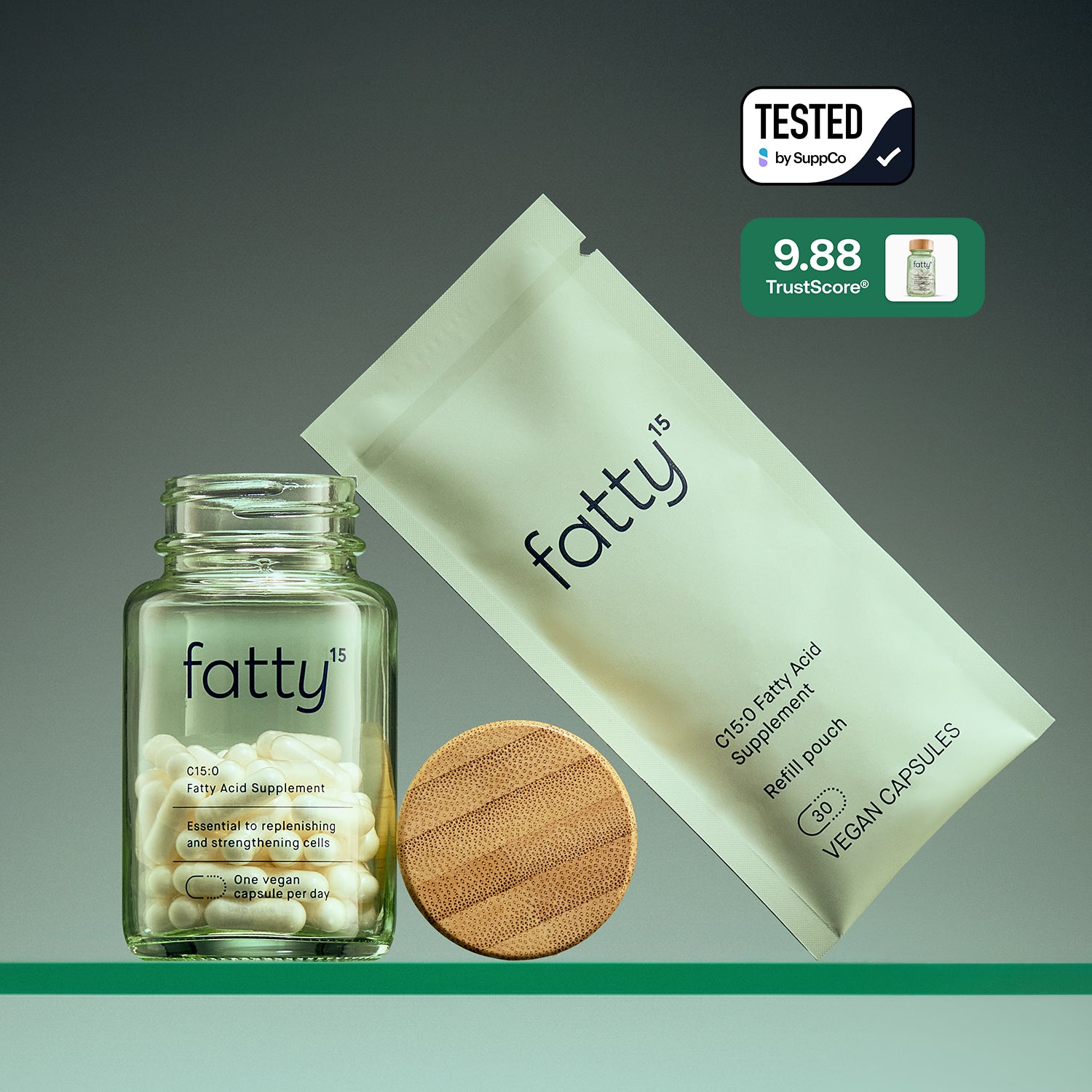
In addition, it’s worth noting that fatty15’s C15:0 supplement passed the highest bar in supplement testing, TESTED by Suppco, earning a TRUST score of 9.88, which puts fatty15 in the top 1% of more than 160,000 supplements tested.
Ongoing Research Related to C15:0 and Brain Aging
Pulling this research together, here's where the science currently stands: C15:0 has been shown to improve health markers across cells, animal models, population studies, and the dolphins where this research began. Its metabolite, pentadecanoylcarnitine, is a likely neuroactive, anti-inflammatory compound.*
Further, more than 150 peer-reviewed studies support the efficacy and essentiality of C15:0.
How To Incorporate C15:0 Into Healthy Aging Routines
If you're interested in exploring C15:0 as part of a healthy aging routine, a few practical steps can help.
Check Your Diet
Evaluate your diet for whole-fat dairy sources, since that's where C15:0 is most naturally found. Keep in mind that you’d need to consume a lot of whole milk to get the essential C15:0 your body needs. At the same time, you’d be consuming a wallop of calories along with bad, even-chain saturated fats that are consistently associated with poor health outcomes.
Know Your Levels
If you want to accurately measure your circulating C15:0 level, you can order a simple at-home test. Most people have C15:0 levels below 0.2% of their circulating fatty acid levels. Researchers agree that circulating levels between 0.2% and 0.4% are optimal. Interestingly, people living in Blue Zones like Sardinia, Italy, have C15:0 levels much higher than this, around 0.64%.
Understand the Risks of Lower Levels
Having low levels of C15:0 can result in a nutrient deficiency known as Cellular Fragility Syndrome. Cellular Fragility Syndrome is common, affecting an estimated 1 in 3 people globally.
This deficiency causes cells to become fragile and unstable and is associated with ferroptosis, a form of cell death that accelerates aging. Thankfully, fixing Cellular Fragility Syndrome is as easy as boosting your C15:0 levels.
From Pods to People
The research that began with dolphins has led to fascinating and promising discoveries about human health and brain aging. As research continues, we can expect more benefits of C15:0 to be discovered, particularly how it supports our bodies and brains at the cellular level.
At fatty15, we remain committed to supporting wellness and longevity from the cells up.
|
*These statements have not been evaluated by the Food and Drug Administration. This product is not intended to diagnose, treat, cure, or prevent any disease. |
FAQs
What is C15:0, and why is it important?
C15:0 is pentadecanoic acid, a recently recognized essential fatty acid that supports overall cellular health, inflammation balance, and aging resilience.*
Does C15:0 support cognitive function and brain health?
Preliminary animal and cell research suggests C15:0 may help maintain brain health and support cognitive function, but more robust human studies are still needed.*
Are there human studies confirming C15:0 benefits for cognition?
Human studies indicate that people with higher C15:0 levels have better overall cognitive performance, including improved memory and mood. Additional studies are underway to further elucidate the cognitive benefits of C15:0.
Sources:


