


Subcutaneous vs. Visceral Fat: What’s the Real Difference?

Seraphina Therapeutics's Highlights
Subcutaneous fat sits just under your skin, while visceral fat wraps around your internal organs. That difference is why one is a much bigger metabolic troublemaker than the other. You can carry excess visceral fat even at a normal body weight, which is part of why the scale alone is an unreliable indicator of metabolic health. Supporting metabolic health goes beyond fat storage location entirely, and C15:0 is one of the newer, more targeted tools for doing it.*
Fat gets talked about as one single thing: something to have less of. Biologically, that's not quite right.
Where fat is stored matters almost as much as how much of it there is, and two people can carry the same amount of body fat with very different metabolic consequences, depending on where it's living.
Let's get into what subcutaneous and visceral fat actually are, what causes each one to build up, and why one tends to be the far more urgent concern.
What Is Subcutaneous Fat?
Subcutaneous fat is the layer sitting just beneath your skin, the fat you can actually pinch on your belly, arms, thighs, or hips.
It makes up the large majority of total body fat (roughly 90% in most people), and it serves useful purposes: insulation, cushioning for muscles and joints, and a reserve energy store your body can draw from when needed. It's the fat most people picture when they think about "body fat,” mostly because it's the fat you can actually see and touch.
Subcutaneous fat accumulates through the same general mechanism as most fat does: consistently taking in more energy than you burn over time, with genetics playing an important role in exactly where your body prefers to store it.
Some people store more around the hips and thighs, while others store more around the midsection. That distribution pattern is largely inherited rather than chosen, which is worth remembering the next time genetics is left out of a conversation about body fat entirely.
What Is Visceral Fat?
Visceral fat is stored deeper, wrapping around your internal organs, liver, pancreas, intestines, inside the abdominal cavity. Unlike subcutaneous fat, you can't pinch visceral fat, which makes it easy to underestimate how much you're carrying. Two people can look nearly identical from the outside and have vastly different visceral fat levels underneath.
Visceral fat is more metabolically active than subcutaneous fat, meaning it behaves less like passive storage and more like an active tissue, releasing fatty acids and inflammatory compounds directly into circulation. Some of that fallout travels straight to the liver, which is one of the key reasons visceral fat causes more downstream trouble than fat stored elsewhere.
The causes of excess visceral fat overlap with subcutaneous fat, chronic caloric surplus, low physical activity, and genetics, but visceral fat accumulation is also more strongly associated with chronic stress, poor sleep, and excessive alcohol intake.
All of these affect cortisol and other hormones specifically tied to abdominal fat storage. It's part of why stress eating tends to show up around the middle for a lot of people, rather than evenly distributed throughout the body at once.
Which One Is More Dangerous?
Visceral fat is the more dangerous of the two, and the reason is biological, not just its location. Because visceral fat is more metabolically active, it releases higher levels of inflammatory cytokines than subcutaneous fat, contributing to chronic, low-grade inflammation throughout the body.
It also sends fatty acids directly to the liver at a higher rate, interfering with the liver's ability to regulate insulin levels, which, over time, can contribute to insulin resistance, elevated LDL cholesterol, and eventually type 2 diabetes. Even the way visceral fat cells grow is different: they tend to enlarge rather than multiply, a pattern researchers have linked to greater inflammatory output than subcutaneous fat typically produces.
Research backs this up with real numbers. Data from the Framingham Heart Study found that for every 1-SD increase in visceral fat, the odds of having metabolic syndrome rose by roughly 4.7 in women and 4.2 in men, a far stronger association than researchers observed for subcutaneous fat.
Visceral fat is also linked to fatty liver disease, gallbladder disease, sleep apnea, and cardiovascular disease, specifically, a fairly long list for a type of fat most people can't even see they're carrying.
Subcutaneous fat isn't entirely off the hook. Excess amounts are still associated with increased risk of type 2 diabetes and cardiovascular disease.
However, some research suggests that fat stored subcutaneously in the hips and thighs may play a mildly protective metabolic role, acting almost like a safe overflow container that keeps excess fat from being deposited in places like the liver and pancreas.
Visceral Fat and Metabolic Illness
Visceral fat is strongly associated with metabolic syndrome and related conditions. However, the relationship isn't a one-way guarantee, and treating it as an absolute rule oversimplifies what's actually a more complex picture.
Some people carry excess visceral fat while still maintaining largely normal metabolic markers, at least for a period of time. This is a pattern researchers sometimes describe as "metabolically healthy obesity," though most evidence suggests this state tends to be temporary rather than a permanent exception.
On the other hand, and arguably more important for how most people think about their own risk, someone can be at a completely normal body weight and still carry a concerning amount of visceral fat, sometimes informally called "skinny fat" or, in research terms, having a normal-weight metabolic obesity profile.
This is why waist circumference and waist-to-hip ratio tend to be better indicators of metabolic risk than weight or BMI alone. A waist measurement of 35 inches or more in women, or 40 inches or more in men, is generally considered a signal of higher visceral fat risk, regardless of what the scale says. This is a genuinely useful number to know even if you've never thought about visceral fat specifically before.
The takeaway here isn't that visceral fat guarantees metabolic illness or that a normal weight guarantees safety from it. It's that fat location is doing real, measurable metabolic work in the background, work that a mirror or a bathroom scale simply can't show you.
Supporting Metabolic Health Beyond Fat Location
Since visceral fat and metabolic health are so closely linked, most of the standard advice for managing one also supports the other. This includes strength training, cardiovascular activity, a diet built around protein and fiber rather than refined carbohydrates, adequate sleep, and stress management.
None of that is new information, but it's worth restating because it remains the foundation. No supplement replaces it, and anyone telling you otherwise is selling something.
What's new to the conversation is cellular-level support, specifically through C15:0, the essential fatty acid that now has more than 150 peer-reviewed studies supporting its broad health benefits.
Metabolic health affects how efficiently your cells are functioning day to day, and that's a piece of the picture that diet and exercise alone don't fully address, since even a well-managed diet can't provide your cells with a nutrient that most modern eating patterns have quietly stopped supplying.
Where C15:0 Fits Into Metabolic Health
C15:0 activates PPAR receptors involved in metabolic signaling and supports AMPK and AKT pathways connected to how efficiently cells process energy.* It also plays a structural role in cell membrane integrity, which matters because stronger, more stable membranes support better mitochondrial function, the process responsible for generating a large share of your body's usable energy.
Clinical research has associated C15:0 supplementation with improved liver enzyme markers, a metabolic health indicator directly relevant to the same fatty-liver risk that visceral fat contributes to.*
Cellular Fragility Syndrome
C15:0 is an essential fatty acid. Essential means our bodies need it to thrive, but can’t make it on their own. We have to get it from food or supplements.
When cell membranes lack sufficient C15:0, they become structurally weaker and more prone to a specific form of cell death called ferroptosis, an iron-dependent process in which fragile membranes break down under oxidative stress.
Ferroptosis has been linked to accelerated cellular aging and is increasingly implicated in the same conditions that visceral fat drives, such as metabolic dysfunction, liver strain, and cardiovascular risk, since organs like the liver depend on stable, resilient cell membranes to regulate insulin, process fat, and manage inflammation in the first place.
This deficiency now has a name: Cellular Fragility Syndrome. Researchers estimate it may affect as many as 1 in 3 people globally, largely because C15:0's primary dietary source, whole-fat dairy, has fallen out of favor over decades of low-fat eating trends.
C15:0 is found in whole-fat dairy products, but only in trace amounts. While avoiding whole milk and full-fat butter netted us some benefits, like skipping excess calories and avoiding some “bad” saturated fats, it caused us to become deficient in C15:0. The solution comes in the form of a once-per-day supplement.
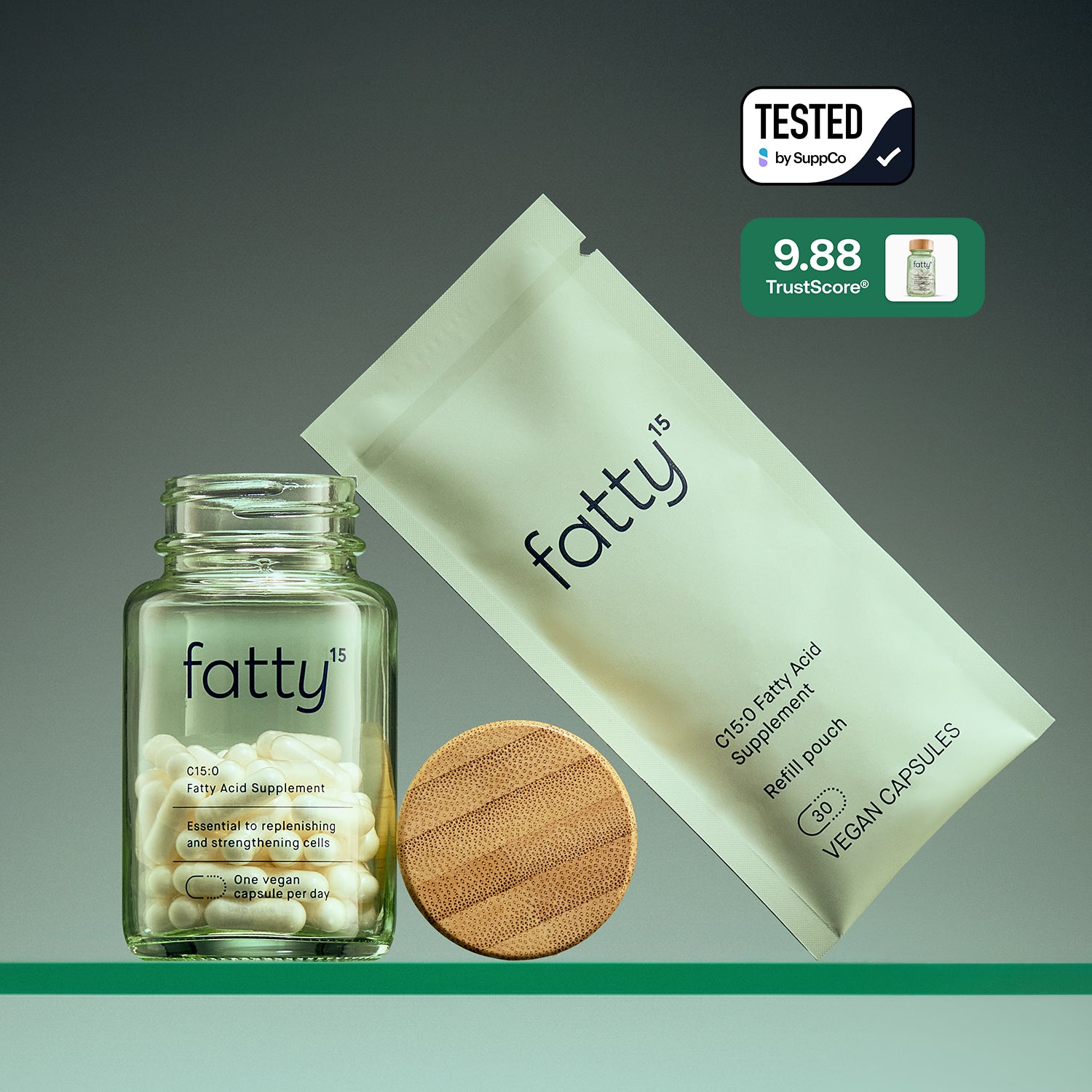
Fatty15’s C15:0 supplement delivers a clinically studied dose of pure, patented, vegan-friendly C15:0, in a single daily capsule without relying on whole-fat dairy. It’s also worth noting that fatty15’s C15:0 supplement passed the highest bar in supplementing test, TESTED by Suppco, earning a TRUST score of 9.88, which is in the top 1% of more than 160,000 supplements tested.
It goes well with exercise and a healthy diet, and it addresses a cellular-level aspect of metabolic health that many otherwise health-conscious routines simply aren't covering yet, mostly because it's a nutrient most people have never heard of and that needs attention in the first place.
FAQs
What's the main difference between subcutaneous and visceral fat?
Subcutaneous fat sits just under the skin and can be pinched, while visceral fat wraps around internal organs deep in the abdominal cavity. Visceral fat is more metabolically active and releases more inflammatory compounds, making it the greater health concern of the two.
Can you have visceral fat at a normal weight?
Yes. Body weight and BMI don't reliably indicate how much visceral fat someone is carrying. Waist circumference and waist-to-hip ratio are generally better indicators of visceral fat and related metabolic risk than weight alone.
Does visceral fat always cause metabolic illness?
Not always, but it's strongly associated with it. Some people maintain normal metabolic markers despite visceral fat for a period, but most evidence suggests this tends to shift over time rather than remain a permanent exception.
How does fatty15 support metabolic health related to visceral fat?
Fatty15 delivers C15:0, which activates PPAR receptors and supports AMPK and AKT pathways tied to metabolic function, and has been associated with improved liver enzyme markers in clinical research.* It works alongside, not instead of, standard habits like diet, movement, and sleep.
|
*These statements have not been evaluated by the Food and Drug Administration. This product is not intended to diagnose, treat, cure, or prevent any disease. |
Sources:
Why is visceral fat worse than subcutaneous fat? | UIC today


