


Is It Possible To Reverse Cellular Aging? The Studies Are Saying “Yes”

Seraphina Therapeutics's Highlights
- A growing body of peer-reviewed research points to a root cause of accelerated cellular aging called Cellular Fragility Syndrome. Multiple published studies suggest pentadecanoic acid (C15:0) helps strengthen cell membranes and support long-term metabolic, liver, and heart health. Fatty15 was created to deliver clinically studied C15:0 in a single daily capsule, so you can support your cells with the nutrient science says many of us are missing.
For a long time, aging was treated as something that simply happened to us, a slow, uniform ticking clock with no dial to turn. That story is changing.
Over the past several years, peer-reviewed studies have begun to describe aging less as an inevitability and more as a biological process, with identifiable mechanisms, measurable markers, and, in some cases, nutritional inputs that appear to influence its pace.
At the center of this shift is a molecule most people have never heard of: pentadecanoic acid, or C15:0. We think that is about to change. Below, we walk through what the science currently supports, where the research is headed, and why we built fatty15 around this specific fatty acid.
Lifespan vs. Healthspan
It is worth pausing on why this question has become so urgent. Longevity science used to focus almost entirely on lifespan, simply adding more years.
The conversation has since shifted toward healthspan, the number of years spent in genuinely good metabolic, cardiovascular, and cognitive condition. That shift matters because it moves the goal away from a single number and toward something people can feel day to day: steady energy, a resilient metabolism, a heart and liver that keep pace, and a mind that stays sharp.
Cellular health sits at the foundation of it, which is exactly why researchers have started looking so closely at the nutrients that support it at that level.
The Cell Is Where Aging Starts
Before we can talk about slowing or supporting healthy aging, it helps to understand where aging actually begins: at the cellular level.
Every organ, tissue, and system in the body is made up of cells, and the health of those cells largely determines the health of the whole. When cells become fragile, leaky, or unstable, downstream effects can include reduced metabolic flexibility, liver strain, cardiovascular stress, and cognitive changes.
This is the foundation of the Cellular Stability Hypothesis, as researchers have named it. Published in the journal Metabolites, this research proposed that a deficiency in C15:0, an essential fatty acid, can leave cell membranes structurally weaker and more prone to a specific kind of cell death called ferroptosis.
Ferroptosis is not the ordinary, planned cell turnover that keeps tissue healthy. It is a more chaotic, oxidative-stress-driven breakdown that is linked to accelerated aging and to metabolic, liver, and heart-related health challenges.
The researchers gave this newly identified nutritional gap a name: Cellular Fragility Syndrome. It is described as the first nutritional deficiency syndrome identified in roughly 75 years, a notable claim in a field that doesn’t hand out new nutrient deficiency syndromes lightly.
The proposed fix in the research is not a drug. It is restoring adequate levels of C15:0, which helps strengthen cell membranes, reduce ferroptosis, and, in turn, support the slower, steadier aging process we would all prefer.
What makes this finding even more important is that it gives us a target to work with. For decades, aging research treated cellular decline as background noise, an unavoidable byproduct of time. Naming a specific, nutritionally addressable mechanism helps magnify the importance of understanding, testing for, and treating C15:0 nutritional deficiencies.
Why C15:0 Is Being Compared to Longevity Compounds
If Cellular Fragility Syndrome sounds like a big claim, the next study makes an even bigger one, at least by scientific standards. Published in Nutrients, this cell-based study compared C15:0 with several well-known longevity-enhancing candidate compounds, molecules already the subject of significant longevity research in their own right.
The findings were notable. Across several hallmark pathways of aging, as well as core components of type 2 diabetes, heart disease, cancer, and nonalcoholic fatty liver disease, the study found that C15:0 shares clinically relevant cell-based activities with these leading longevity compounds, in some cases matching or exceeding them.
For an essential fatty acid found naturally in whole-fat dairy, that is a striking result. It’s part of why C15:0 has moved from a nutritional footnote to a genuine subject of longevity science.
It also helps to understand why researchers chose this particular comparison in the first place. Longevity-enhancing candidate compounds are typically identified because they influence multiple hallmark pathways of aging simultaneously, rather than acting on a single, narrow target.
That multi-pathway activity is part of what makes them interesting to longevity science, and it is exactly the profile the Nutrients study found in C15:0. A nutrient that shows up across metabolic, cardiovascular, and liver-related pathways simultaneously is a very different proposition than one that only moves a single biomarker, and it is part of why this particular essential fatty acid has attracted so much research attention in such a short window of time.
What Human Trails Are Showing
Cell-based studies matter, but people want to know what happens in actual human bodies. This is where the TANGO randomized controlled trial, published in the American Journal of Clinical Nutrition, becomes relevant. Researchers studied an Asian-adapted Mediterranean diet paired with C15:0 supplementation in the context of fatty liver disease.
In addition to the benefits already seen from the diet itself, the C15:0 supplementation was associated with lower LDL cholesterol, lower total fat mass, and favorable shifts in the gut microbiome, including support for Bifidobacterium adolescentis, a probiotic bacterium separately associated with longevity in other research. These are the kinds of measurable results that turn a nutrient conversation from theory to practice.
A separate randomized controlled trial in young adults with overweight or obesity, published in The Journal of Nutrition, found that daily C15:0 supplementation safely raised circulating C15:0 levels. Among participants who reached a specific circulating threshold, the study reported clinically relevant improvements, including lower liver enzymes and higher hemoglobin after twelve weeks.
What stands out about these two trials is the consistency of the underlying signal. Different research teams, different study populations, and different primary endpoints all pointed to the same core idea: that raising circulating C15:0 levels correlates with measurable improvements in markers of metabolic and liver health.
In nutrition science, where individual studies can be noisy and results do not always replicate, such convergence across independent trials carries real weight. It is also the reason for building a supplement specifically designed to help people reach and maintain those same circulating C15:0 levels studied in the clinical research.
The Brain and Cognitive Angle
Cellular aging does not stop at the liver or the heart. Cognitive health is deeply tied to how well brain cells resist inflammation and oxidative damage over time, which is why a 2025 study in the International Journal of Molecular Sciences should be considered.
Researchers studying aging-associated amyloid-beta plaques and neuroinflammation identified two dose-dependent activities of C15:0, specifically FAAH and MAO-B inhibition, that appeared to lower amyloid-beta formation, reduce neuroinflammation, and support cognitive function in the animal models studied.
This research is still developing, and animal models are not a substitute for human cognitive trials. But the findings add cognitive health to the growing list of systems where C15:0 appears to play a distinct, supportive role, alongside metabolic, liver, heart, and cellular stability research.*
So, Can Cellular Aging Actually Be Reversed?
The peer-reviewed published studies referenced above do not claim that C15:0 reverses aging in the sense of turning back a clock.
What the science supports is something more measured and, we would argue, more meaningful: C15:0 appears to help restore and maintain the structural integrity of cells, reduce a specific form of accelerated cell death, and support the metabolic, liver, heart, and cognitive systems that tend to decline with age.*
In other words, cellular aging can be reversed in a way that will make you a calendar year younger, but it can be reversed to make you biologically more youthful. We’d argue that’s a more important win.
Why Fatty15 Was Built for Your Cellular Health
Given everything above, the practical question becomes simple: how do you actually get clinically studied levels of C15:0 into your daily routine? Whole-fat dairy contains C15:0, but not at the levels used in the research, and it also comes with an even-chain saturated fat load that is frequently linked to poor health outcomes.
This is exactly why fatty15 created a C15 supplement. Fatty15 delivers a patented, pure, and vegan form of C15:0, in a single daily capsule. Designed specifically so people could achieve meaningful circulating C15:0 levels without overhauling their diet or consuming large amounts of dairy fat.*
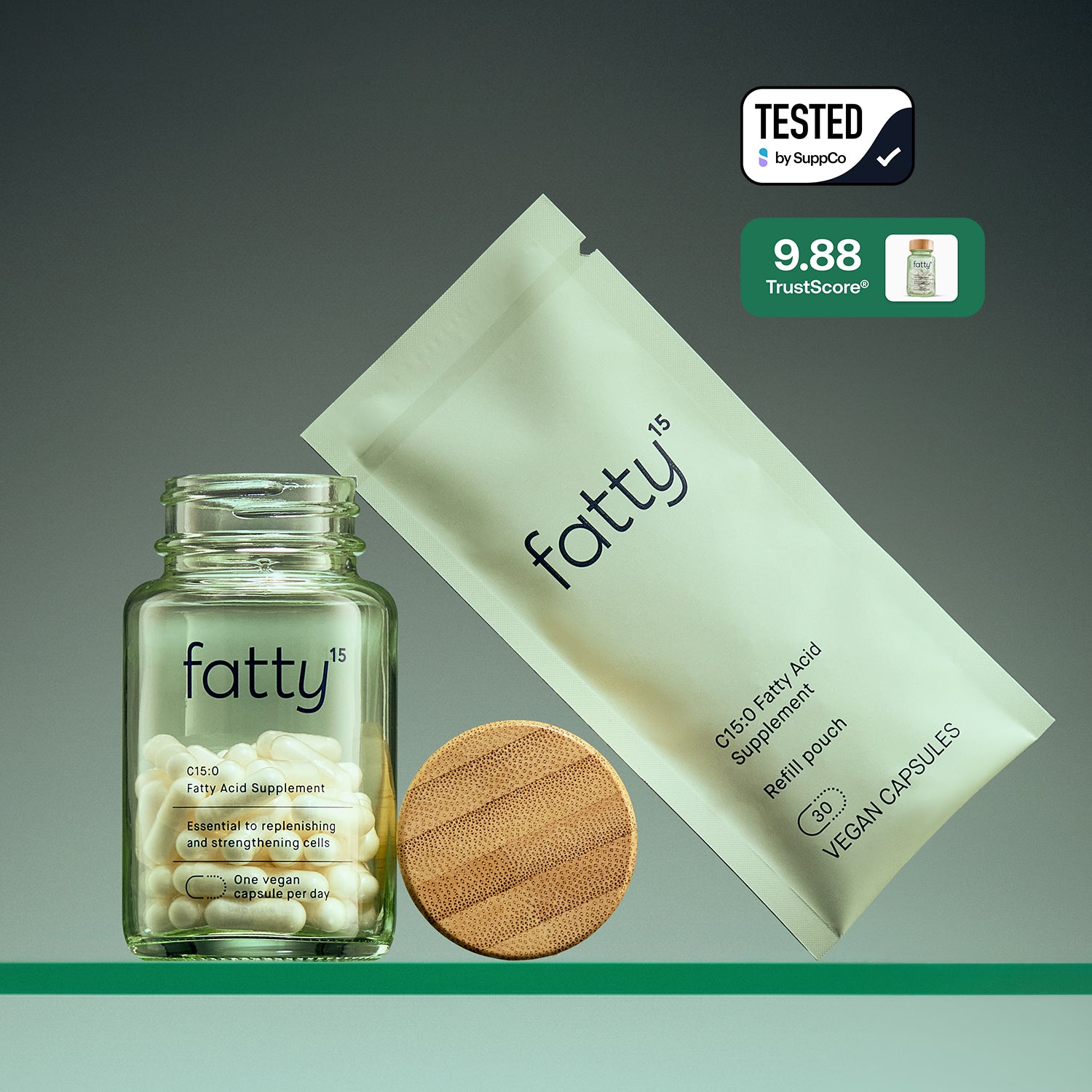
In addition, it’s worth noting that fatty15’s C15:0 supplement passed one of the most difficult supplement tests, TESTED by Suppco, earning a TRUST score of 9.88, putting it in the top 1% of all supplements tested.
You Can Take Actionable Steps To Reverse Cellular Aging
The science is deep and the pattern is consistent. C15:0 supports cell membrane strength, helps counter ferroptosis, and is associated with measurable results across metabolic, liver, heart, and cognitive markers. That pattern gives us confidence in fatty15, and we think it makes this molecule worth paying attention to as the science around cellular longevity continues to evolve.*
Whatever stage of life you are in, the underlying takeaway is the same. Cellular health is not a distant, abstract concept reserved for laboratories and journal articles. It is the foundation on which everything else is built, and it responds, at least in part, to the nutrients we give it. That is the entire premise behind fatty15, and it is why we are so dedicated to helping you take care of your cells.
|
*These statements have not been evaluated by the Food and Drug Administration. This product is not intended to diagnose, treat, cure, or prevent any disease. |
FAQs
What is Cellular Fragility Syndrome?
Cellular Fragility Syndrome is a nutritional deficiency syndrome described in a 2024 study published in Metabolites. It is associated with insufficient C15:0 levels, which the research links to weaker cell membranes, increased ferroptosis, and accelerated aging-associated health challenges affecting metabolic, liver, and heart health.
Does C15:0 actually reverse aging?
The current peer-reviewed published studies support that C15:0 reverses cellular aging. The science supports that C15:0 strengthens cell membranes, reduces a form of accelerated cell death called ferroptosis, and supports several biological systems, including the metabolic, liver, heart, and cognitive systems, that tend to decline as we age.
How is fatty15 different from omega-3 supplements?
Research published in PLOS ONE found that C15:0 demonstrated broader, safer, clinically relevant activities than omega-3 across 12 human cell-based disease systems. Omega-3 is a well-established beneficial fatty acid, and C15:0 is being studied as a distinct essential fatty acid with its own broad supportive role in cellular health.
Is fatty15 backed by clinical research?
Yes. fatty15 delivers a proprietary form of pure C15:0, the same essential fatty acid studied in the randomized controlled trials and cell-based research referenced throughout this article, including the TANGO trial and the Journal of Nutrition supplementation study.
Sources:


