


Is Butter a Saturated Fat?

Seraphina Therapeutics's Highlights
- Butter fits into the USDA 2025–2030 Dietary Guidelines, and moderation is still recommended.
- C15:0 is naturally present in whole-fat dairy (such as butter) and has been found to support long-term health and wellness.
- Fatty15 offers a consistent, targeted source of C15:0, an essential saturated fatty acid with long-term health benefits.
- Butter fits into the USDA 2025–2030 Dietary Guidelines, and moderation is still recommended.
Is that delicious pat of butter on your toast or veggies actually good for you? For decades, the answer has been the center of debate. Butter has been painted alternately as a villain or a wholesome kitchen staple.
As the 2025–2030 U.S. Dietary Guidelines for Americans are rolled out, and dietary thinking changes, it’s a great time to take a clear look at what saturated fats are, where butter fits in, and what all this has to do with nutrients like C15:0, the naturally occurring odd‑chain fatty acid behind the supplement fatty15.
What Is Saturated Fat?
Saturated fat is a type of dietary fat in which most of the fatty acid chains have no double bonds between carbon molecules. In other words, they are “saturated” with hydrogen. Saturated fats are solid at room temperature and are found in a variety of animal and plant sources.
Foods that contain high levels of saturated fats include butter, whole-fat dairy products, fatty cuts of meat, processed meats, coconut and palm oil, cocoa butter, and prepackaged, processed foods like snack cakes.
Saturated fats are important in public health guidance and nutrition because they can influence blood lipid levels and cardiovascular health.
The 2025–2030 Dietary Guidelines for Americans retain the recommendation that saturated fat intake should be limited to less than 10% of total daily calories. That means if you’re eating a 2,000‑calorie diet, no more than about 22 grams of your daily calories should come from saturated fat.
However, the type of saturated fat is also important and nuanced.
Is Butter a Saturated Fat?
Short answer, yes. Butter is a saturated fat. Most of the fat in butter is saturated, with only a small amount of monounsaturated and polyunsaturated fat. For that reason, when you eat butter, you’re consuming mostly saturated fat.
For context, a typical tablespoon of butter contains roughly 7 grams of saturated fat, making it one of the more concentrated dietary sources of this fat type.
Why Does Saturated Fat Matter? What the USDA Guidelines Say
Each iteration of the U.S. Dietary Guidelines for Americans tries to translate the best available science into eating patterns that support long‑term health. In the 2025–2030 edition, saturated fat remains a key nutrient of interest.
The Saturated Fat Limit
The dietary patterns recommended by the guidelines emphasize consuming a variety of foods that are nutrient-dense. Saturated fats (including those from butter and full‑fat dairy) are still limited because research consistently shows that replacing saturated fats with unsaturated fats often improves blood lipid profiles, particularly by lowering LDL (“bad”) cholesterol.
However, it’s important to point out that the saturated fats responsible for these increases are even-chain saturated fatty acids.
Odd vs. Even
Not all saturated fats behave the same in the body. Most of the saturated fat found in meat, butter, and common cooking oils is even-chain fatty acids (like palmitic and stearic acid). These are the fats that are consistently associated with “bad” heart health and high cholesterol.
By contrast, odd-chain saturated fats, which are found naturally in whole-fat dairy, appear to have different effects. Studies suggest they may help promote balanced cholesterol levels and metabolic health. This distinction highlights why focusing on specific fatty acids, rather than lumping all saturated fats together, is becoming an important nuance in nutrition science.
The Guidelines: Key Takeaways
Nutrition science definitely has its complexities. If you want the takeaway for saturated fats’ position in the new food guidelines, it’s this:
- Enjoy whole‑food sources of nutrients, including those that contain saturated fats.
- Be mindful of how much saturated fat you consume relative to your total calorie intake.
- When possible, favor unsaturated fats from plant oils, nuts, and seeds over saturated fats as part of a heart‑healthy pattern.
So, where does that ultimately leave butter? Let’s settle the great butter debate.
Is Butter Bad for You?
The short answer is that there is no short answer.
Butter does contribute saturated fat, and that’s something the guidelines still caution us about. However, it also contains both even-chain and odd-chain saturated fat. Specifically, butter and other whole-dairy products contain C15:0, also known as pentadecanoic acid.
C15:0 has recently garnered interest for its positive roles in metabolism and cellular health. Unlike more abundant saturated fats (like palmitic acid), odd‑chain fatty acids like C15:0 are present in much smaller amounts in butter.
The question then becomes whether or not consuming butter for the benefits of C15:0 is a good idea. To answer that question, we first need to consider the benefits of C15:0.
What Is C15:0 (Pentadecanoic Acid)?
You may not see it listed on a nutrition label, but C15:0 is present in dairy fat, especially in whole‑fat products like butter, sour cream, and certain cheeses. C15:0 supports our bodies by strengthening and repairing our cells, the very foundations of our health.
It does so by:
- Keeping cell membranes strong*
- Improving mitochondrial function*
- Improving the gut microbiome*
- Targeting 6 out of the 12 cellular hallmarks of aging*
- Improving liver enzymes*
Even more importantly, one study found that supplementation with C15:0 supported healthier LDL cholesterol levels. This is particularly relevant and newsworthy as we continue to shift the narrative around saturated fat and how it works in our bodies.
Unlike we previously believed, not all saturated fat is bad, and not having enough of the “good” saturated fat could even lead to a dietary deficiency.
What Is Cellular Fragility Syndrome?
As published in the scientific journal Metabolites, low body levels of C15:0 can result in fragile cells that accelerate cellular aging and increase the risk of developing chronic metabolic, heart, and liver conditions.* This nutritional C15:0 deficiency syndrome has been named Cellular Fragility Syndrome and may be impacting as many as 1 in 3 people worldwide.
How much C15:0 do we need to prevent this nutritional deficiency syndrome? C15:0 levels should represent more than 0.2% of your total fatty acids, but one study showed that people with levels between 0.4% and 0.55% had better-protected long-term heart health.* Finding out your own levels can be done through your primary care provider ordering a blood test, or by clicking here to order a simple at-home testing kit.
Because C15:0 is present in relatively small amounts in food, some people may not get much of it from their diet alone. So, should you increase your butter intake?
More Butter or Something Better?
Butter does contain C15:0, but it also contains a lot of other fats that count toward your saturated fat limit. Even though you can get C15:0 from foods like butter and whole‑fat dairy, eating enough to meet a specific nutrient target through butter alone would push you past recommended limits for saturated fat, in addition to creating more unexpected problems.
The Breakdown Issue
In milk (and other foods), C15:0 is attached to branches of lipids called triacylglycerides, aka triglycerides. That means our gut has to use digestive enzymes to break down these triacylglycerides to release C15:0 as a free fatty acid.
Once C15:0 is released, it is ready to be absorbed. These multiple steps can make our absorption of C15:0 from foods less efficient.
The Calorie Issue
Whole-fat dairy products provide excess calories, including sugars. The calories in whole-fat milk likely explain why a large-scale recent study showed that adults who drink more dairy milk are more likely to have a higher body weight.
The Cow Issue
Consumption of whole-dairy requires, well, cows. If you are vegan or looking to reduce your carbon footprint, you’re definitely not going to consume more dairy as part of your health plan.
For these reasons, getting your C15:0 from a supplement is a smarter and easier choice.
Fatty15: The Easy Way To Get C15:0
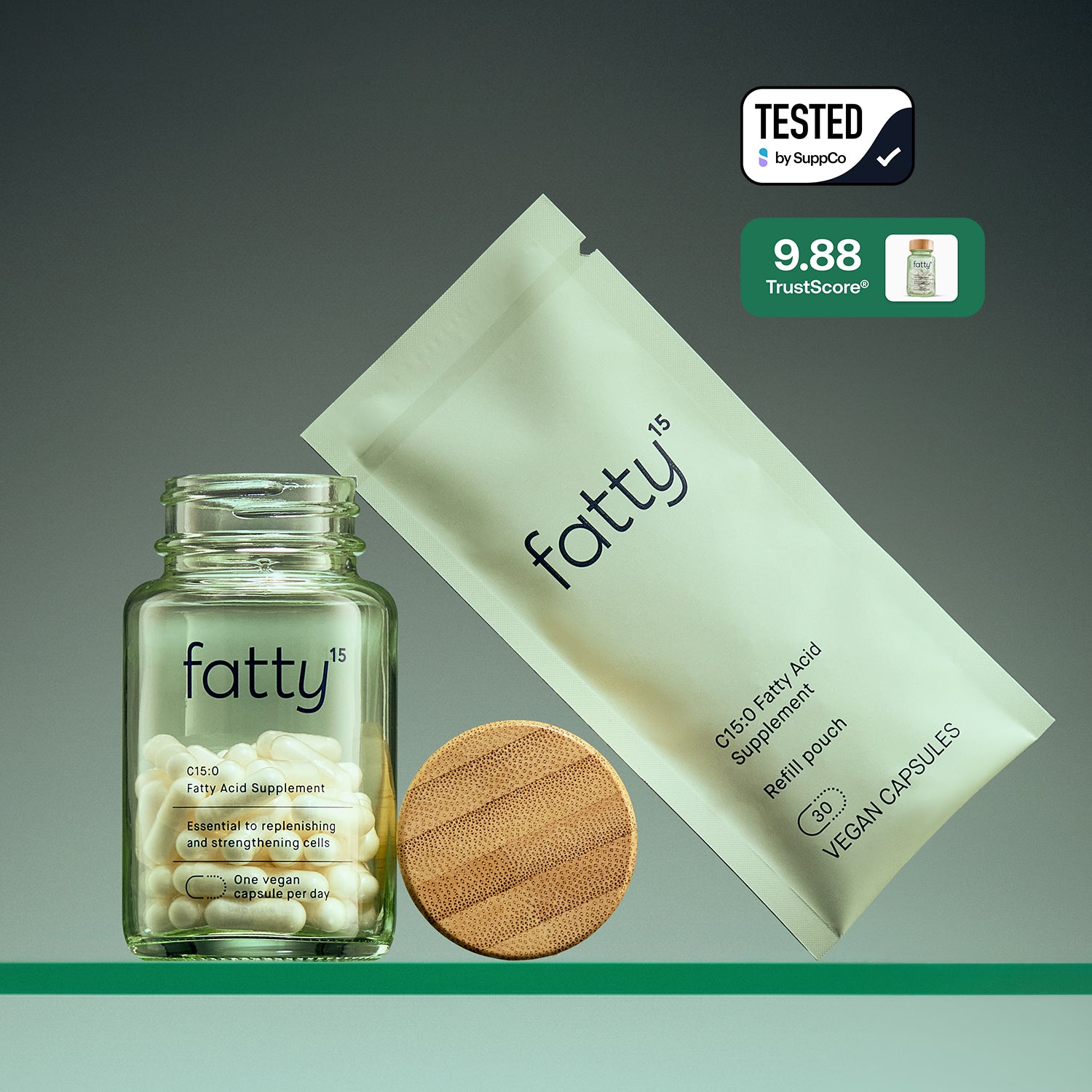
Fatty15 is the first and only supplement that contains the pure, vegan-friendly form of C15:0 known as FA15™. This once-a-day supplement contains all the C15:0 you need, and nothing you don’t. At just one calorie per dose, you can skip the cows, calories, and unhealthy saturated fats.
While food sources remain important for overall nutrition, a supplement can help bridge gaps when nutrient levels in food are low and dietary patterns limit overall intake of saturated fats.
It’s worth noting that C15:0’s emerging research highlights that not all fatty acids are nutritionally or metabolically the same and that some saturated fats like C15:0 are essential for our long-term health and wellness.
Putting It All Together: Smart Fat Choices
So, is butter a saturated fat? Yes. Butter is predominantly saturated fat, and it's something the U.S. Dietary Guidelines recommend keeping in moderation. However, saturated fat isn’t one single thing, nutritionally speaking. Within saturated fats are hundreds of different fatty acids that all behave the same in the body.
Odd‑chain fatty acids like C15:0 are just one example of this nuance. They’re present in whole‑fat dairy like butter, but also appear in other natural fats at low levels. Fatty15 offers a way to access C15:0 more directly without consuming large amounts of high‑saturated‑fat foods.
Supporting your health is important, and adding something to your health stack is something you should do with research and intention. If you’re looking for a way to promote your long-term health and stay in line with the new health and wellness guidelines, taking fatty15 is a smart decision.
FAQs
Is butter a saturated or unsaturated fat?
Yes. Butter is a saturated fat made primarily from milk fat. It contains two types of unsaturated fats: odd-chain saturated fats and even-chain saturated fats.
What do cardiologists say about butter?
Cardiologists generally advise limiting butter due to its high saturated fat content, which can raise bad cholesterol (LDL) and increase heart disease risk. However, there is growing support in the medical literature that some saturated fats in butter are actually beneficial for our long-term health.
What saturated fats should I avoid?
You should avoid foods high in saturated fats, primarily animal products like fatty meats (bacon, sausage, ribs, skin-on poultry) and full-fat dairy (butter, cheese, cream, whole milk), plus tropical oils (coconut, palm), and processed items like pastries, fried foods, and baked goods, as these raise “bad” cholesterol (LDL) and increase heart disease risk.
A growing body of evidence supports that some saturated fatty acids in full-fat dairy such as C15:0 are beneficial for our long-term health.
What is the healthiest butter to eat?
The healthiest butter is generally grass-fed butter, as it offers higher levels of omega-3s, conjugated linoleic acid and C15:0.
|
*These statements have not been evaluated by the Food and Drug Administration. This product is not intended to diagnose, treat, cure, or prevent any disease. |
Sources:
Facts about saturated fats: MedlinePlus Medical Encyclopedia
Dietary Guidelines for Americans, 2025–2030


