



How Much Saturated Fat Is in an Egg?

Seraphina Therapeutics's Highlights
- Eggs contain a modest amount of saturated fat, most of it concentrated in the yolk.
- Saturated fat quality matters more than quantity, and eggs sit in a unique nutritional category.
- Modern research is reframing how saturated fat from whole foods like eggs fits into a healthy diet.
Let’s face it: eggs are controversial. First, they were praised as a perfect protein, then criticized for cholesterol, then cautiously welcomed back into balanced diets thanks to nutrition science and a very clever marketing campaign.
The incredible, edible egg is under the microscope once again as conversations around saturated fat evolve. For such a small food item, it begs the question of just how much saturated fat it can contain and whether that amount should be concerning.
The answer is more complicated than many headlines suggest, especially as modern nutrition science moves away from blanket judgments about fat.
The Short Answer: Saturated Fat in One Egg
A large whole egg contains about 1.5 to 1.6 grams of saturated fat. For context, most dietary guidelines recommend keeping saturated fat intake below about 10 percent of total daily calories, which translates to roughly 20 grams per day for someone eating 2,000 calories.
That means one egg contributes a relatively small portion of daily saturated fat intake. It’s important not to stop there. What matters just as much as the amount of saturated fat is the type of fat, the food matrix it comes in, and how it interacts with the rest of your diet.
Where the Fat in Eggs Comes From
Nearly all of an egg’s fat is found in the yolk. The white is essentially fat-free and composed mostly of water and protein. The yolk, however, is a dense package of lipids, vitamins, minerals, antioxidants, and essential nutrients designed to support early development.
The total fat content of a large egg is about 5 grams. Of that, roughly one-third is saturated fat, and the rest is monounsaturated and polyunsaturated fat.
Eggs are not a concentrated source of saturated fat compared to foods like butter, cream, or processed meats. They deliver a mix of fats within a whole-food structure that also includes choline, vitamin D, selenium, lutein, and zeaxanthin.
Why Eggs Were Lumped Into the “Bad Fat” Category
For years, eggs were restricted because of saturated fat and cholesterol. Early dietary guidance assumed that cholesterol in food directly translated to cholesterol in the bloodstream. Eggs, with about 185 milligrams of cholesterol per yolk, became an easy target. The guidance was simple: Eat eggs and have a heart attack.
Over time, large population studies and controlled feeding trials showed that dietary cholesterol has a much smaller effect on blood cholesterol for most people than previously thought. As a result, explicit cholesterol limits were removed from U.S. dietary guidelines.
However, eggs still carried some nutritional baggage because they contain saturated fat. For decades, saturated fat was treated as a single nutrient to be minimized across the board, when it isn’t that simple.
Saturated Fat Isn’t One Thing
Saturated fat is a category, not a single molecule. It includes many different fatty acids that vary in chain length, structure, and biological behavior. Most discussions about saturated fat focus on even-chain saturated fatty acids, which are common in processed foods and are commonly associated with negative health outcomes.
But eggs, like other whole animal foods, also contain smaller amounts of odd-chain saturated fatty acids, including C15:0, an odd-chain saturated fatty acid that our bodies actually need. Odd-chain saturated fats are different. Unlike even-chain fats, the body does not efficiently produce them internally, which means we have to get them from our diet or supplements.
Research has repeatedly found that higher blood levels of odd-chain saturated fats are associated with better long-term metabolic outcomes , including lower risk of type 2 diabetes and cardiovascular disease. Eggs are not the richest source of C15:0, but they contribute to overall intake within a diverse diet.
The Egg as a Whole Food Matrix
Nutrition science increasingly emphasizes the concept of the food matrix. This refers to how nutrients interact within a whole food, rather than acting in isolation. Eggs are a prime example. The fats in eggs are packaged with high-quality protein that promotes satiety, phospholipids, fat-soluble vitamins, and antioxidants.
This matrix influences how the body processes egg fat. Eating saturated fat within a whole food like an egg doesn’t produce the same metabolic response as consuming saturated fat in a refined or ultra-processed form.
That difference helps explain why observational studies often show neutral or favorable health outcomes associated with egg consumption, even though eggs contain saturated fat.
Eggs, LDL Cholesterol, and Context
One reason saturated fat remains controversial is its relationship with LDL cholesterol.
Some people experience a modest increase in LDL cholesterol when they consume more saturated fat. Eggs can raise LDL slightly in certain individuals, but they often raise HDL cholesterol at the same time. HDL, or “good” cholesterol, plays a role in reverse cholesterol transport, moving cholesterol away from arteries.
Additionally, eggs may influence LDL particle size, shifting toward larger, less dense particles that are considered less dangerous. Importantly, cardiovascular risk is not determined by LDL cholesterol alone. Inflammation, insulin sensitivity, oxidative stress, and triglyceride levels all play major roles.
When eggs are eaten as part of a balanced diet that emphasizes whole foods, fiber, and unsaturated fats, their modest saturated fat content doesn’t appear to meaningfully increase cardiovascular risk for most people.
Eggs in the Revised Dietary Guidelines
The most recent Dietary Guidelines for Americans continue to recommend moderation with saturated fat, but they also emphasize overall dietary patterns rather than single foods.
Eggs now appear regularly in recommended eating patterns, including Mediterranean-style and protein-forward diets. This inclusion reflects a growing consensus that eggs can fit into a healthy diet without concern for saturated fat when consumed in reasonable amounts.
Notably, the guidelines increasingly acknowledge that foods like eggs and dairy cannot be evaluated solely by their saturated fat content. Their nutrient density and real-world health outcomes matter.
Comparing Eggs to Other Sources of Saturated Fat
It’s useful to compare the saturated fat in eggs to that in other common foods.
For instance, one tablespoon of butter contains 7 grams of saturated fat, more than four times the amount found in an egg. A slice of processed pizza or a serving of fried fast food can easily deliver several times more saturated fat, often alongside refined carbohydrates and sodium. Eggs, by contrast, deliver their saturated fat in a nutrient-rich package with minimal processing.
What About Eating Eggs Every Day?
Large observational studies have examined egg consumption at levels of up to one egg per day, and in some cases more. For most healthy individuals, daily egg consumption has not been associated with increased cardiovascular disease risk .
In people with diabetes or existing metabolic disease, results are more mixed, emphasizing the importance of individual context. However, even in these populations, whole dietary patterns appear to matter more than egg intake alone.
The key takeaway is that eggs are not a major driver of excessive saturated fat intake for most people. Other dietary choices play a much larger role.
The Bigger Saturated Fat Conversation
As research advances, scientists are questioning whether focusing on total saturated fat intake is the most effective way to guide health outcomes. Emerging evidence suggests that specific saturated fatty acids have different biological roles.
Among them, C15:0 has gained attention for its involvement in:
-
Balanced cellular signaling
-
Lower LDL cholesterol
Unlike omega-3 fatty acids, which are widely recognized as essential, C15:0 flew under the radar for decades. Declining consumption of whole-fat dairy and traditional foods may have contributed to lower circulating levels in modern populations.
Now, C15:0 is not only accepted as an essential nutrient, but there is evidence to support that not having enough C15:0 in our diet causes a deficiency syndrome called Cellular Fragility Syndrome.*
Cellular Fragility Syndrome
As published in the scientific journal Metabolites, low body levels of C15:0 can result in fragile cells that accelerate cellular aging and increase the risk of developing chronic metabolic, heart, and liver conditions. This nutritional C15:0 deficiency is thought to affect as many as 1 in 3 people worldwide.
Most people today have C15:0 levels around 0.2% of total fatty acids. Experts agree that people need to maintain circulating C15:0 levels between 0.2% and 0.4% to protect against Cellular Fragility Syndrome.
However, a prospective cohort study that followed more than 4,000 people over 16 years showed that those with C15:0 levels between 0.40% to 0.55% had the lowest risk of developing heart disease .*
Luckily, Cellular Fragility Syndrome is easily fixed by elevating your circulating levels of C15:0.* The best way to do that, however, might not be consuming eggs.
Leveling Up Your C15:0
Eggs, while beneficial for most, don’t contain much C15:0. While it is found in trace amounts in whole-fat dairy products, increasing your intake of whole milk, butter, and cheese isn’t the solution for increasing your C15:0 levels. There are a few reasons why.
First, whole-fat dairy contains small amounts of C15:0, but is abundant in even-chain saturated fats that aren’t good for our bodies. Second, whole-fat dairy can pack in an abundance of calories that can wreck your daily diet. Finally, consuming dairy is off the table for vegans and people who do not use animal-based products.
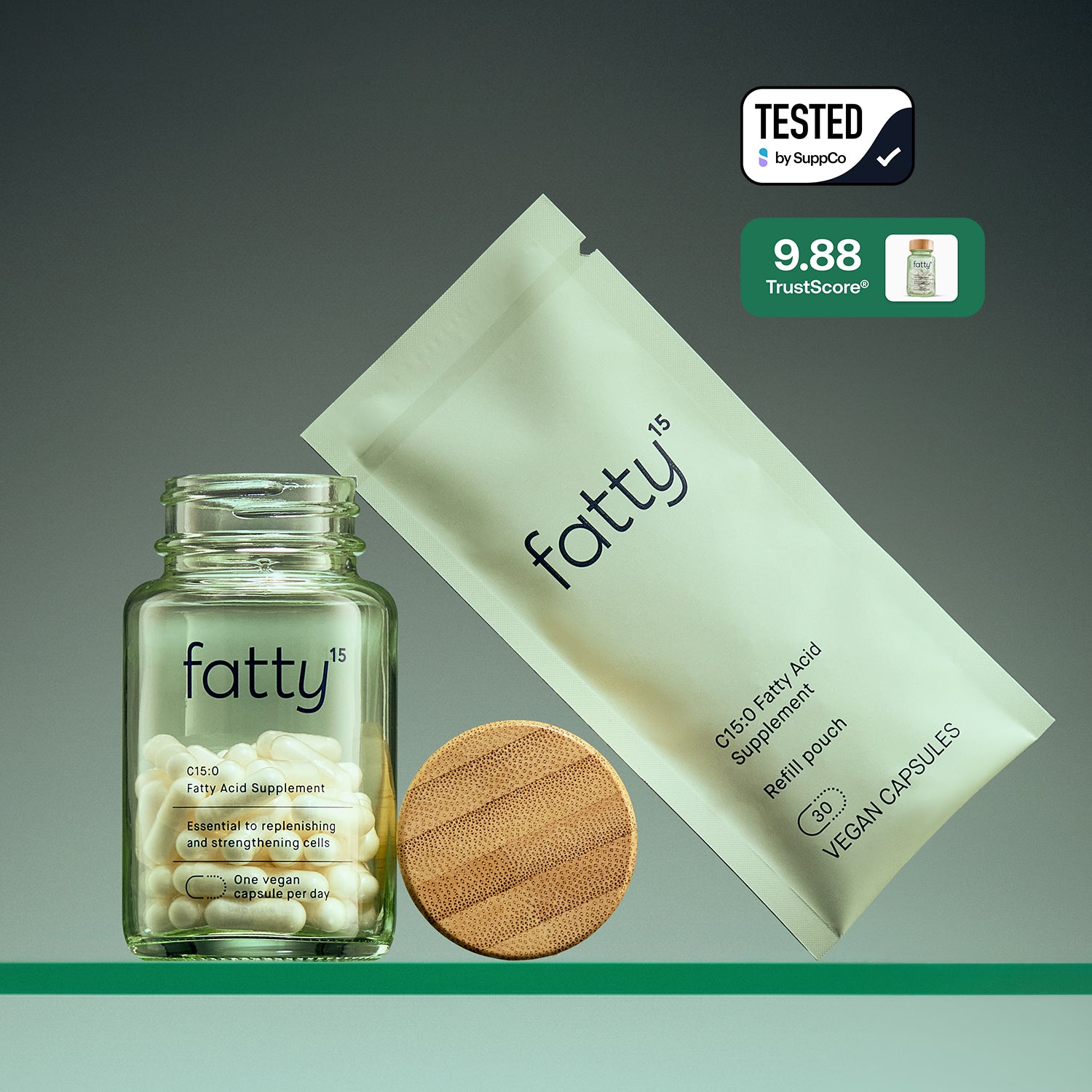
A good solution is to get our C15:0 from a supplement. Fatty15™ is the first and only supplement that contains the pure, vegan-friendly version of C15:0. At just one calorie per dose, it gives you everything you need, and nothing you don’t. It’s the smart way to level up your C15:0 level and protect against Cellular Fragility Syndrome.
Good News for Egg Lovers
So how much saturated fat is in an egg? About 1.5 grams, and for most people, that is nothing to worry over. As science continues to refine how we think about fats, eggs remain a reminder that nutrition is rarely about single numbers. It’s about context, quality, and balance.
So, go ahead and have an egg with breakfast. While you’re at it, level up your health stack with fatty15 and support your wellness and health from the cells up.
FAQs
How much saturated fat is in 2 eggs?
A serving of two large eggs contains 3.5 grams of saturated fat.
Can I eat eggs if I have high cholesterol?
For most healthy people, one daily egg fits a heart-healthy diet, but moderation (around 4–7 yolks/week) is often advised for those with existing high cholesterol or heart disease.
What does Dr. Gundry say about eggs?
Dr. Gundry says eggs are generally okay on his lectin-free diet, but only if they are from pasture-raised chickens fed a lectin-free diet (not grains/soy). Dr. Gundry also notes that C15:0 is a beneficial saturated fat that is present in eggs.
Which food is highest in saturated fat?
Foods highest in saturated fat include fatty meats (beef, pork, lamb), processed meats (sausage, bacon), full-fat dairy (butter, cheese, cream, ice cream, whole milk), fried foods, and baked goods, with tropical oils (coconut, palm) also being significant sources, often found in packaged items and desserts.
|
*These statements have not been evaluated by the Food and Drug Administration. This product is not intended to diagnose, treat, cure, or prevent any disease. |
Sources:
Dietary Guidelines for Americans
Egg intake and cognitive function in healthy adults: A systematic review of the literature | PMC


