


How Many Essential Nutrients Are There Now?

Seraphina Therapeutics's Highlights
Essential nutrients are substances the body needs but cannot produce on its own, meaning they must come from diet or supplementation. For decades, only two fatty acids, an omega-3 and an omega-6, met the criteria for essentiality. Science now supports a third: C15:0. C15:0, also known as pentadecanoic acid, is supported by broad evidence for cellular, metabolic, liver, and heart health, backed by a growing body of peer-reviewed research.
For most of the twentieth century, the list of essential nutrients felt fixed. Textbooks listed vitamins, minerals, and a small handful of essential fatty acids, and that list rarely changed. But nutrition science doesn’t stand still, and every so often, new evidence reshapes what we thought we understood about what our bodies truly need.
One of those shifts is happening now, with the recognition of a third essential fatty acid: pentadecanoic acid (C15:0).
What Makes a Nutrient Essential?
An essential nutrient is a substance that the body needs to maintain baseline health but cannot produce in adequate amounts on its own. Because the body cannot manufacture enough of it internally, an essential nutrient must be obtained through diet or supplementation.
This type of nutrient is different from a nutrient the body can synthesize, even if that synthesis requires certain building blocks or cofactors. Classic examples include vitamins and minerals such as vitamin C, vitamin D, and iron. Each was identified because a deficiency produced a specific, recognizable condition.
Vitamin C deficiency causes scurvy. Vitamin D deficiency causes rickets. In each case, researchers connected low levels of a nutrient to a defined health outcome, then showed that restoring the nutrient resolved the condition. That pattern is one of the hallmarks scientists look for when identifying a true nutritional deficiency.
Fatty acids have their own, smaller category within essential nutrients. For decades, only two fatty acids met this bar: an omega-3 (alpha-linolenic acid, or ALA) and an omega-6 (linoleic acid, or LA). Both are polyunsaturated fats and were identified as essential nearly a century ago. Since then, the list has not grown until recently.
The Unexpected Discovery Behind C15:0
The story of C15:0 begins in an unlikely place: a US Navy program dedicated to the long-term health of aging dolphins. While studying these animals, a veterinary epidemiologist noticed that dolphins with higher levels of a particular fatty acid in their circulation tended to have fewer age-related health issues.
That fatty acid was C15:0, also known as pentadecanoic acid, an odd-chain saturated fat. This observation led to several years of additional research examining whether the same relationship held true in humans. In 2020, those findings were published in Nature's Scientific Reports, describing C15:0's role in supporting healthy cells.
Since that publication, more than 150 additional peer-reviewed studies have explored C15:0's effects, and the evidence has continued to build toward recognizing it as the third essential fatty acid, joining ALA and LA on that short list.*
Why C15:0 Is Unlike Other Saturated Fats
C15:0 belongs to a category called odd-chain saturated fatty acids, distinct from the even-chain saturated fats found in many processed and animal-based foods. This distinction is important.
Even-chain saturated fats have long been associated with less favorable health outcomes when consumed in excess. Odd-chain saturated fats like C15:0 appear to behave differently, supporting a range of cellular functions rather than working against them.*
Science supports that C15:0 plays a role in several interconnected systems in the body. At the cellular level, C15:0 has been shown to help strengthen cell membranes, supporting their resilience against age-related breakdown.
Research also points to a role in mitochondrial function, the process by which cells generate energy, with studies noting improvements in mitochondrial performance alongside a reduction in reactive oxygen species. These byproducts can otherwise contribute to cellular stress.*
C15:0 also naturally activates PPAR receptors found throughout the body. These receptors help regulate metabolism, including cholesterol and glucose homeostasis, help support liver function, and assist with immune response, mood, and sleep. This receptor activity may help explain why C15:0 has been associated with a broad set of health markers rather than a single, narrow benefit.*
The Case For a Newly Recognized Deficiency
Alongside the case for C15:0 as essential, researchers have also proposed a related concept: that low C15:0 levels may contribute to a specific pattern of cellular vulnerability.
This has been described in the peer-reviewed journal Metabolites, which outlines how low C15:0 levels can leave cells more fragile and susceptible to a form of cell breakdown called ferroptosis. In turn, this cellular fragility has been linked to poorer metabolic, liver, and heart health markers over time.
Most people today have circulating C15:0 levels around 0.2 percent of total fatty acids. Research suggests that maintaining levels between 0.2 and 0.4 percent may help support cellular resilience, while higher levels appear to offer further benefit.
A cohort study following more than 4,000 people over 16 years found that those with C15:0 levels between 0.40 and 0.55 percent had the lowest risk of developing heart disease. Separately, populations in longevity-associated regions, sometimes called blue zones have shown C15:0 levels roughly three times higher than the general population, alongside notably high rates of long lifespan.*
Why C15:0 Levels May Be Declining
If C15:0 offers this range of benefits, why aren't we getting enough of it? The answer lies in changes in dietary patterns over the past several decades. C15:0 is naturally present in trace amounts in whole-fat dairy products, including whole milk and butter.
Starting in the 1970s, dietary guidelines encouraged a shift away from full-fat dairy and, more generally, saturated fats, largely out of concern for cardiovascular health. As a result, consumption of whole-fat dairy products declined significantly, and with it, a key dietary source of C15:0.
Science now supports a more nuanced picture. Not all saturated fats behave the same way in the body, and odd-chain saturated fats like C15:0 appear to function quite differently from their even-chain counterparts. Still, simply returning to higher whole-fat dairy consumption is not a straightforward solution.
Whole-fat dairy products bring along a substantial amount of calories, natural sugars, and even-chain saturated fats, the very fats that guidelines originally aimed to reduce. Plant-based milk alternatives, meanwhile, lack C15:0 altogether, meaning the broader shift toward plant-based diets may be compounding the decline in C15:0 intake rather than resolving it.*
How Fatty15 Helps Close the Gap
Given the practical challenges of reaching adequate C15:0 levels through diet alone, supplementation has emerged as a more consistent approach. Fatty15’s C15 supplement was developed specifically to address this gap, delivering C15:0 in a form designed for both purity and ease of daily use.
Fatty15’s C15 supplement contains a single ingredient: a pure, vegan-friendly, sustainably produced form of C15:0. Unlike the C15:0 found naturally in whole-fat dairy, which is bound to triglycerides and requires digestive enzymes to be broken down and released before it can be absorbed, fatty15’s C15:0 is already in its free fatty acid form. This means less work for the digestive system and more consistent absorption.
Fatty15 also avoids the tradeoffs that come with trying to reach adequate C15:0 levels through whole-fat dairy consumption. Each capsule contains just one calorie, without the added sugars or even-chain saturated fats found in whole milk and butter.
It is also completely vegan, allowing people to support their C15:0 levels without relying on dairy at all, a meaningful consideration given that plant-based milk alternatives lack C15:0 altogether.
Because fatty15’s C15 supplement delivers a consistent, measured amount of C15:0 daily, it offers a more predictable path toward the circulating levels associated with better long-term cellular, metabolic, and heart health outcomes in research to date, rather than leaving intake to the variability of diet alone.
How C15:0 Fits Into The Essential Fatty Acid Playbook
Omega-3 and omega-6 fatty acids remain well-established and valuable parts of a balanced diet, with decades of research behind their role in heart, brain, and overall health. C15:0 does not replace these fatty acids. Instead, it appears to work through distinct mechanisms, offering its own set of cellular and metabolic benefits alongside those already provided by omega-3 and omega-6.
Where C15:0 differs is in its form and function. It is naturally stable in a pure powder state, unlike many other fatty acids, including omega-3 fatty acids, which are typically oils at room temperature. This stability supports a smaller daily dose without the odor or aftertaste that can come with fish oil supplements. Fatty15’s supplement delivers C15:0 through a single daily capsule.
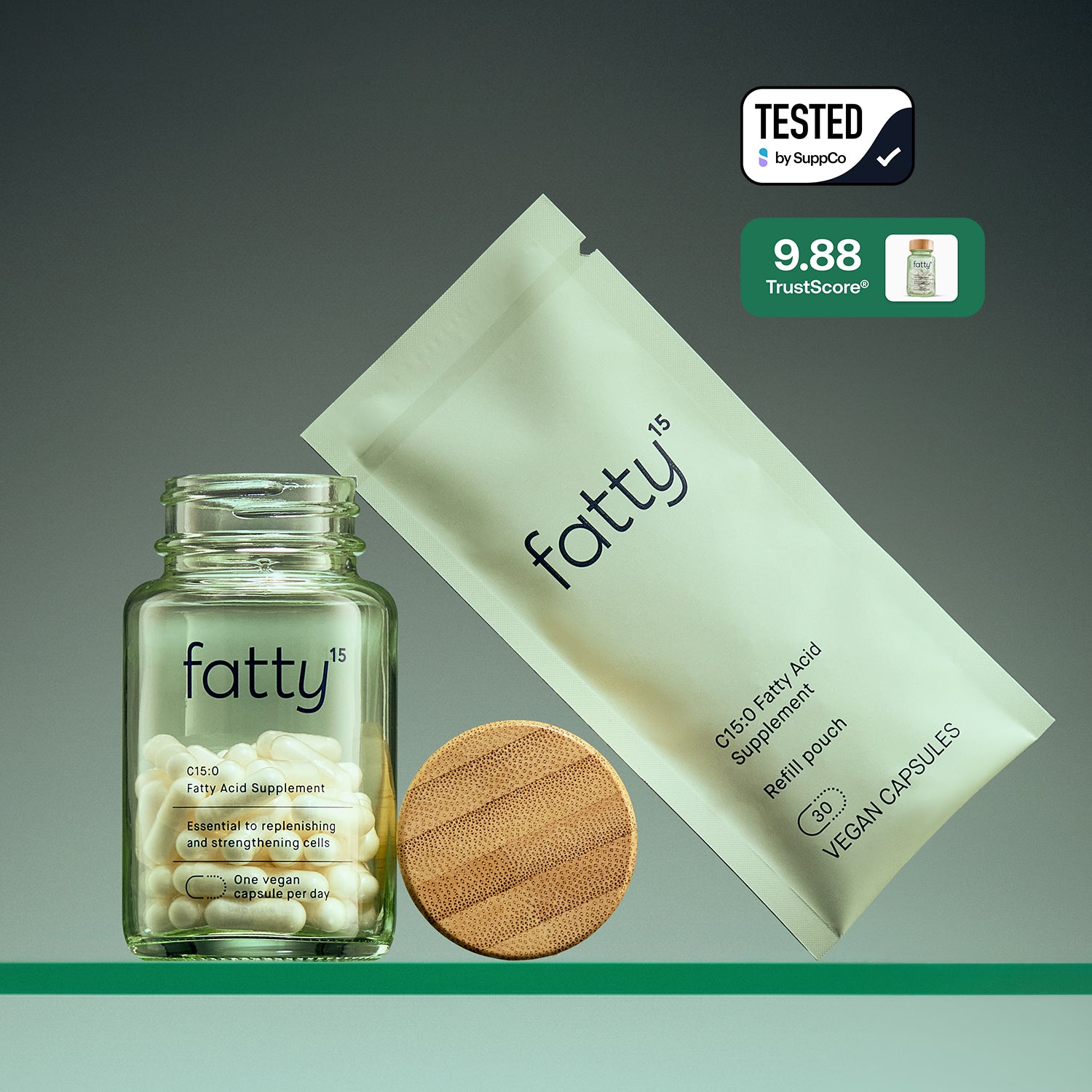
In addition, it’s worth noting that fatty15’s C15:0 supplement passed one of the highest bars in supplement testing, TESTED by Suppco, earning a TRUST score of 9.88 (in the top 1% of all supplements tested).
The Future of Nutrition Guidelines
The recognition of a third essential fatty acid represents a meaningful shift in how we think about nutrition. Nutritional science tends to move cautiously, and updates to something as foundational as the list of essential nutrients are rare.
As more research accumulates, the conversation is shifting from whether C15:0 deserves a place among essential fatty acids to how best to help people reach adequate levels. Given the dietary shifts of recent decades, supplementation has emerged as a practical way to help support healthy C15:0 levels, particularly for those who don’t regularly consume whole-fat dairy products.
If you want to support healthy C15:0 levels today, fatty15 offers a simple, once-daily option. With a single, pure ingredient and a small, vegan-friendly capsule, it is designed to fit easily into a daily routine without calories, sugars, or saturated fats from animal sources that come with consuming whole-fat dairy.
Explore fatty15 to learn more about supporting your long-term cellular, metabolic, and heart health.*
|
*These statements have not been evaluated by the Food and Drug Administration. This product is not intended to diagnose, treat, cure, or prevent any disease. |
FAQs
Are there 6 or 7 essential nutrients?
There are six major classes of nutrients. Eating well is a balancing act that combines all six. The nutrients in the food you eat benefit your body in different ways. Macronutrients provide energy and keep your body working.
What are the essential fatty acids?
The essential fatty acids are linoleic acid (an omega-6), alpha-linolenic acid (an omega-3), and pentadecanoic acid (C15:0), which the human body cannot synthesize and must obtain through diet. They're required for cell membrane structure, brain function, and as precursors to hormone-like signaling molecules.
What are the 19 essential nutrients?
Vitamins A, B, C, D, E, K, B12, B9, calcium, magnesium, iron, zinc, potassium, sodium, phosphorus, selenium, copper, iodine, and chromium.
What to eat to get all essential nutrients?
The best approach to ensure you get a variety of vitamins and minerals in the proper amounts is to adopt a broad, healthy diet. This emphasizes fruits and vegetables, whole grains, beans and legumes, low-fat protein, and dairy products.
Sources:


