


C15:0 in Young Adults: What a Randomized Controlled Trial Found About Liver Health and Hemoglobin

Seraphina Therapeutics's Highlights
A 12-week randomized controlled trial in young adults found that C15:0 supplementation increased C15:0 levels, thereby improving liver enzyme markers and red blood cell stability. C15:0 helps support cellular health by strengthening cell membranes and supporting mitochondrial function, along with many other clinically relevant benefits.* Fatty15 provides a third-party-tested C15:0 supplement that contains a pure, patented ingredient in a vegan-friendly capsule.*
C15:0, also known as pentadecanoic acid, is an odd-chain saturated fatty acid naturally found in whole-fat dairy products and some fish and plants. Science increasingly supports the idea that C15:0 has broad health benefits and plays an essential role in metabolic and cellular health.*
As interest in next-generation essential fatty acids grows, so does the volume of large population meta-analyses and clinical research examining what C15:0 does in the human body. A recent randomized controlled trial examined C15:0 supplementation in young adults with overweight or obesity, tracking its effects on physiological biomarkers of metabolic and liver health over 12 weeks.
For anyone interested in evidence-based approaches to metabolic and cellular wellness, this trial offers some key insights into targeted C15:0 levels to support liver and red blood cell health. Here's what it found.
Overview of the Trial Design and Population
Understanding what a study can tell us starts with understanding how it was built. A randomized controlled trial (RCT) is a clinical study where participants are randomly assigned to receive either the experimental intervention or a placebo, a design that helps minimize bias and more reliably measure cause-and-effect.
This trial used a randomized, double-blind, placebo-controlled design over 12 weeks, meaning neither participants nor researchers knew whether they were receiving C15:0 or a placebo until the study concluded.
The trial enrolled approximately 30 adults, both men and women, ages 18 to 40, all of whom had been overweight or obese.
Here's a quick summary of the trial's design:
With the design established, let’s look at what the trial actually found.
Impact of C15:0 Supplementation on Liver Health Markers
One of the more notable findings involved liver health. Daily C15:0 supplementation increased circulating C15:0 levels, though not uniformly across participants. Much of this variation was attributable to adherence. If a participant reliably took C15:0 supplementation daily, they were more likely to have increased C15:0 levels.
Those who consistently supplemented with C15:0 and achieved blood concentrations above 5 μg/mL showed clear reductions in ALT and AST.
ALT and AST are blood tests used to measure liver health; elevated levels can indicate liver cell injury or inflammation. Reductions in these markers among responders suggest a meaningful biological effect.
These trial results build on earlier observational research linking higher serum C15:0 levels to less liver fat and a lower risk for nonalcoholic fatty liver disease (NAFLD) and its more advanced form, NASH.
Effects of C15:0 on Hemoglobin and Red Blood Cell Stability
The trial also tracked red blood cell health, an area where C15:0 has previously shown clear effects. Participants who supplemented with C15:0 and achieved C15:0 levels above 5 μg/mL also had significant increases in hemoglobin. This marker reflects improved red blood cell stability.*
Hemoglobin is the oxygen-carrying protein in red blood cells, and stable hemoglobin and red blood cell counts are important for energy, focus, and cardiovascular health. These findings are consistent with earlier preclinical research showing that oral C15:0 helped prevent anemia and reduced hepatic iron accumulation in animal models.*
An Emerging Threshold Effect
The results above support prior studies showing a key threshold effect for C15:0 health benefits. Specifically, it appears we need to have more than 5 μg/mL (approximately equal to 0.2% total fatty acids) of circulating C15:0 to support cardiometabolic, red blood cell, and liver health. Importantly, this clinical trial showed that 20 out of 30 participants at baseline had C15:0 levels below this threshold.
Further, only those who were supplemented with C15:0 and achieved circulating C15:0 levels above 5 μg/mL showed a benefit within this population and 12-week timeframe.
Safety and Tolerability of C15:0 Supplementation
On the safety side, the findings were strong. C15:0 supplementation was safe and well-tolerated in this study and in other clinical trials, with no adverse events attributed to it.
As an ingredient, C15:0, including the form used in fatty15’s C15:0 supplement, is GRAS (Generally Recognized as Safe), meaning it's considered safe at fatty15’s intake levels.
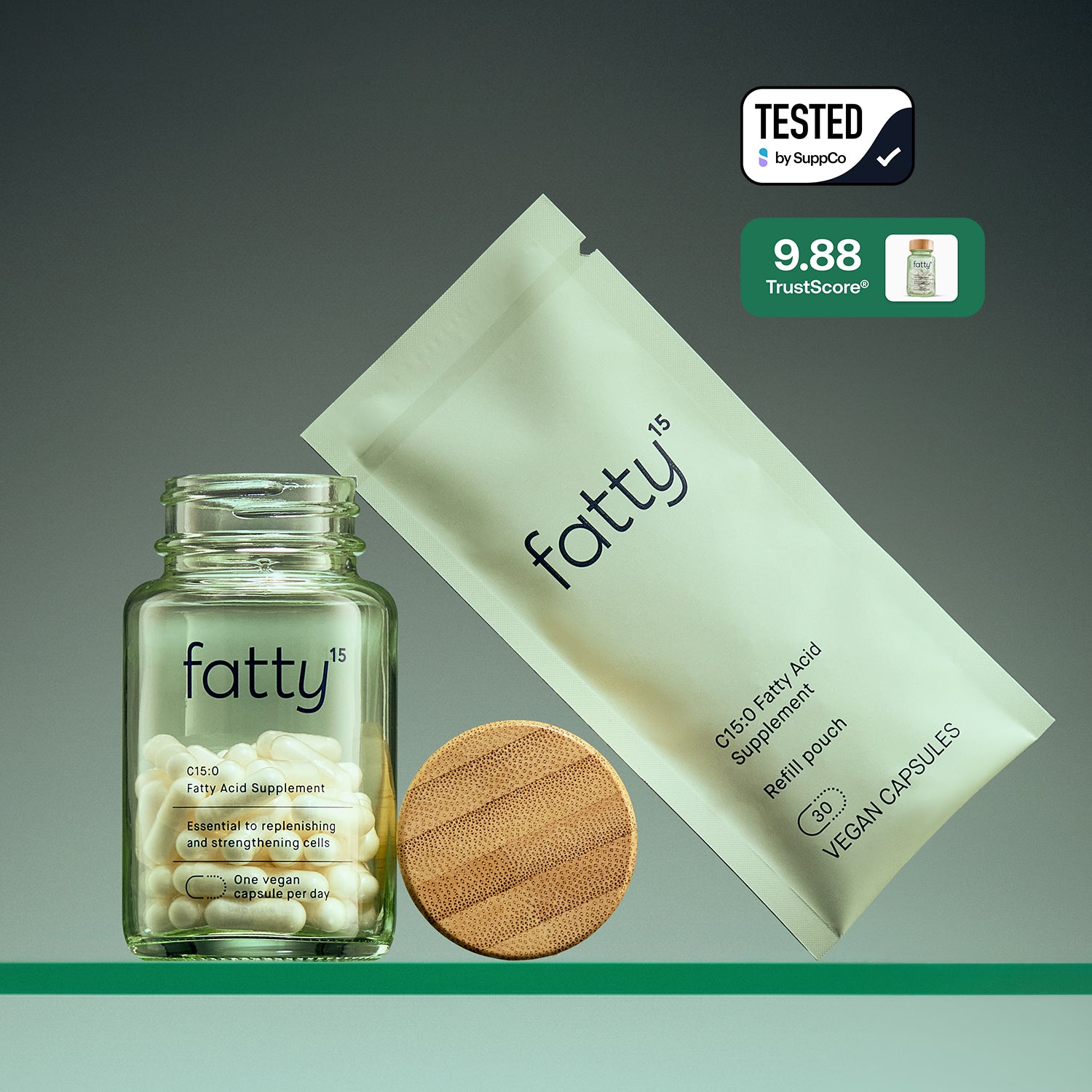
In addition, it’s worth noting that fatty15’s C15:0 supplement passed the highest bar in supplement testing, TESTED by Suppco, earning a TRUST score of 9.88, putting it in the top 1% of more than 160,000 supplements tested.
Limitations of Current Research and Need for Further Studies
While this study helped to validate a key circulating C15:0 threshold needed to support liver and red blood cell health, no single trial tells the whole story, and this one has some limitations worth mentioning:
-
The primary RCT was relatively small, with approximately 30 participants, which limits the extent to which the findings can be generalized.*
-
Adherence issues related to not taking the C15:0 supplement daily had a significant effect, which limited the number of responders. There is a need to closely monitor protocol adherence in future clinical trials to better identify other potential areas of variable responses.*
-
Larger, longer-duration, and more diverse trials, including studies in people with NAFLD/NASH, across a wider age range and with different ethnic backgrounds, will help to better understand who benefits most and under what conditions.*
Science supports treating early clinical findings like these as a promising foundation contributing to the larger body of consistent supportive evidence for C15:0’s health benefits, including mechanistic studies, dose-dependent human cell-based studies, in vivo studies, numerous prospective cohort meta-analyses, and other clinical trials.
Further research will continue to help clarify how C15:0 best fits into long-term metabolic and cellular health.
What To Do Now
This 12-week trial adds meaningful human evidence that C15:0 supplementation can support liver enzyme markers and red blood cell stability, particularly among people who reached higher blood concentrations.* In addition, we know from prior research that C15:0 supports health and longevity in our cells.
Increasing C15:0 levels is easy with fatty15’s C15:0 supplement. It contains 100 mg of pure, patented, sustainably produced, vegan-friendly C15:0. Taking it once daily can raise your circulating C15:0 levels and support your long-term health and wellness.
Not sure if your C15:0 levels need a boost? There’s an easy way to tell. You can have your healthcare provider perform a blood test to measure your circulating fatty acids, or click here for an easy-to-use at-home test. If your C15:0 levels are low, supplementing with fatty15 is a good way to restore and optimize your blood levels.
FAQs
Does C15:0 support liver health?
Current human trials show improvements in liver enzyme markers with C15:0 supplementation. While preclinical studies have repeatedly shown that C15:0 can directly support multiple components of liver health (including supporting healthy immune responses, iron balance, and tissue function), additional clinical trials are needed to better understand C15:0’s role in supporting long-term liver health. It is important to note that supplements, including C15:0 supplements, are not intended to manage, treat, or cure diseases, including fatty liver disease.
Can C15:0 increase hemoglobin in young adults?
Clinical trial evidence indicates C15:0 supplementation increases hemoglobin among people who achieved C15:0 levels > 5 μg/mL.
Is C15:0 safe for long-term use in young adults?
Short-term studies found C15:0 to be well-tolerated and safe. The long-term safety of C15:0 supplementation in young adults can be supported by longer-term studies. Further, C15:0 is naturally present in dairy products, and long-term prospective cohort studies have repeatedly shown that higher C15:0 levels are associated with better long-term cardiometabolic health.
How should I choose an essential fatty acid supplement for my health goals?
Look for supplements supported by strong and consistent scientific evidence, third-party testing, transparent labeling, and ingredients that align with your specific health objectives and dietary preferences.
Sources:
Randomised controlled trials—the gold standard for effectiveness research | PMC


